

Black-chested Snake Eagle | A Complete Birding Guide
Discover Black-chested Snake Eagle identification and where to see itOverview
The Black-chested Snake Eagle is a large bird of prey with a dark chest and pale underparts. It is found in open savannas and grasslands across Africa. Often seen soaring or perched on trees, it hunts snakes and other reptiles. Its bold appearance and hunting style make it a striking species.








Gallery
Summary
Best Places To See
The Black-chested Snake Eagle is most reliably found in open savanna and lightly wooded areas where visibility is high and reptiles are abundant. Kruger National Park offers some of the most consistent sightings, particularly in areas with open terrain and scattered trees that provide ideal hunting perches. Etosha National Park provides a strong complementary option with wide-open landscapes that support soaring behaviour and easy detection. These locations are reliable because a combination of open habitat, stable prey availability, and good visibility allows the species to hunt effectively while remaining highly visible to observers.
Best Time Of Year To See
The Black-chested Snake Eagle can be seen throughout the year, but sightings are most consistent during warmer months when reptile activity increases and birds hunt more frequently. During this time, prey movement improves hunting success and visibility. Thermal currents also support extended soaring, making birds easier to detect in the sky. In cooler months, reptile activity decreases, reducing hunting frequency. Late morning to early afternoon is often the most productive period, when rising temperatures encourage both reptile movement and soaring behaviour.
Identification
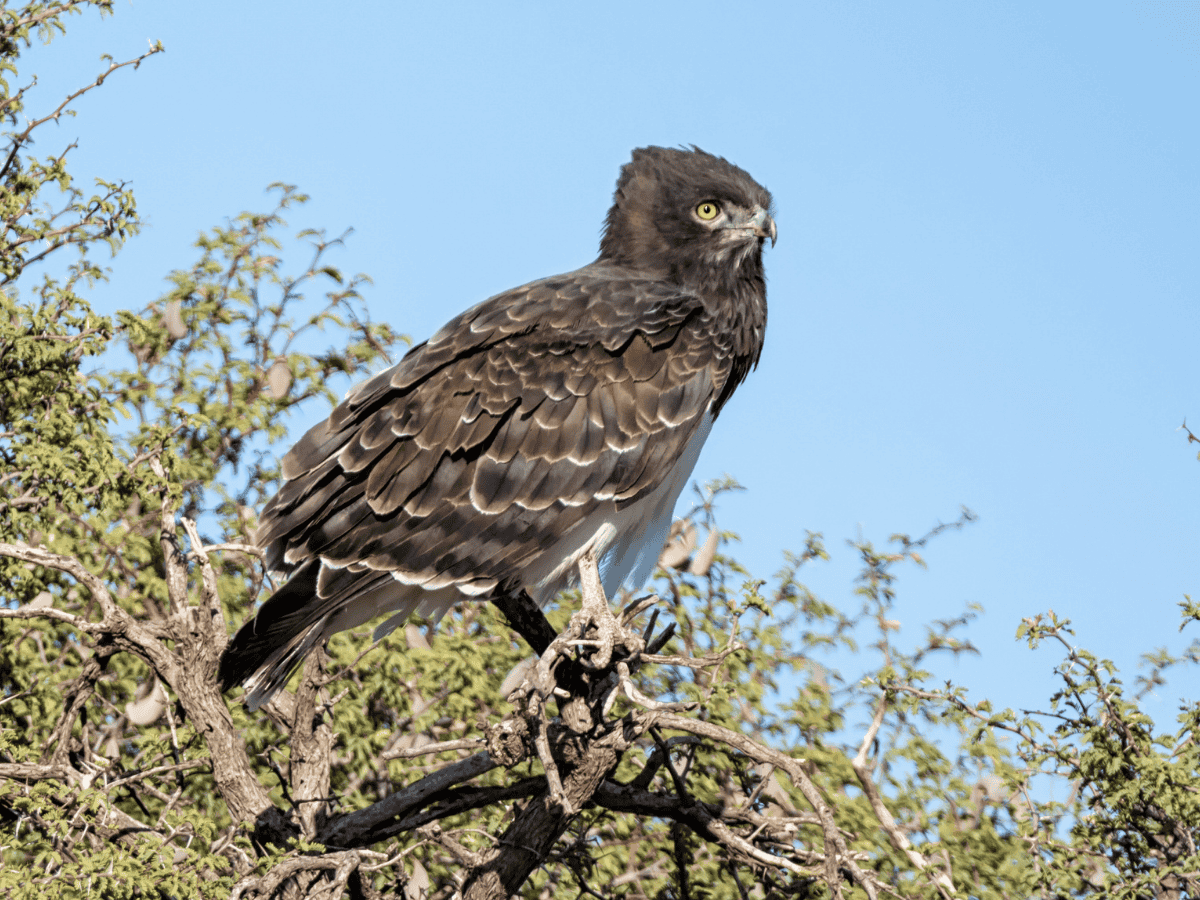
The Black-chested Snake Eagle is a large raptor with pale underparts and a bold black band across the chest, which is its most distinctive feature. It has broad wings, a short tail, and a relatively large head. Its bright yellow eyes stand out clearly. In flight, it shows a strong, steady wingbeat and a pale underside with contrasting markings. Males and females are similar in appearance. It can be confused with other snake eagles, but the black chest band makes identification straightforward.
Behaviour
The Black-chested Snake Eagle feeds mainly on snakes and other reptiles, hunting from elevated perches or while soaring. It often scans the ground carefully before making a swift descent to capture prey. The species is usually solitary and highly territorial. It may call occasionally, especially during breeding season. Travellers are most likely to observe it perched on trees or poles, or soaring slowly while searching for food.
Diet
The Black-chested Snake Eagle feeds primarily on snakes, but also takes lizards and other small reptiles. It hunts by watching from a perch or soaring above open ground before striking with speed and precision. Feeding activity is closely linked to reptile behaviour, which increases during warmer conditions. Its specialised diet reflects its important role in controlling reptile populations within savanna ecosystems.
Habitat
The Black-chested Snake Eagle prefers open savanna, grassland, and lightly wooded areas where visibility is high and prey is accessible. It is most often found perched in exposed positions or soaring above open landscapes. This habitat supports both hunting and movement. Travellers are most likely to encounter it in open environments with scattered trees and good sightlines.
Conservation Status
The Black-chested Snake Eagle is considered stable and widespread, with no major threats affecting overall populations across its range. Its adaptability to different open habitats supports its resilience. However, habitat degradation and human disturbance can impact local populations. Protected areas such as Kruger National Park and Etosha National Park help maintain suitable conditions. Conservation of open ecosystems supports the long-term presence of this species.
Interesting Facts
The Black-chested Snake Eagle is highly specialised for hunting snakes and can handle venomous species with precision. Its bold chest marking makes it one of the easiest snake eagles to identify. It often spends long periods perched, scanning for prey. Its powerful build allows it to subdue relatively large reptiles.
Folklore
Birds of prey are often associated with strength and awareness in African folklore. The Black-chested Snake Eagle’s focus on snakes may symbolise control over hidden dangers. Its calm, watchful behaviour reflects patience and observation. In some interpretations, raptors represent vision and understanding, reinforcing this species’ connection to awareness and balance within natural systems.