

Chacma Baboon | A Complete Safari Guide
Understand chacma baboon behaviour and where to see them on safariOverview
The chacma baboon is a large and highly adaptable primate, known for its long snout, strong build, and expressive behaviour. It is found across southern Africa in a wide range of habitats, from savannas and woodlands to mountains and coastal areas. Baboons live in large troops with complex social structures, often seen grooming, foraging, or moving together. For travellers, they offer some of the most interactive and relatable wildlife sightings. Their intelligence and behaviour provide insight into social animal life on safari.









Gallery
Summary
Best Places To See
Chacma baboons are most reliably seen in diverse, open habitats where troops move freely between feeding and sleeping sites, with Kruger National Park standing out as a flagship destination due to consistently high troop densities and regular roadside sightings. Adjacent private reserves such as Sabi Sands Game Reserve and Timbavati Game Reserve offer equally dependable encounters, often with more natural, undisturbed behaviour. In Botswana, Chobe National Park and Moremi Game Reserve provide frequent sightings along river systems and floodplains, while in Namibia, Etosha National Park delivers predictable encounters around waterholes and open plains where baboons gather daily.
Best Time Of Year To See
The best time to see chacma baboons is during the dry season, when troops move more predictably between feeding areas and water sources. Shorter vegetation improves visibility. They are active throughout the day and commonly seen in open areas. In the wet season, they spread out slightly but remain easy to find.
Identification
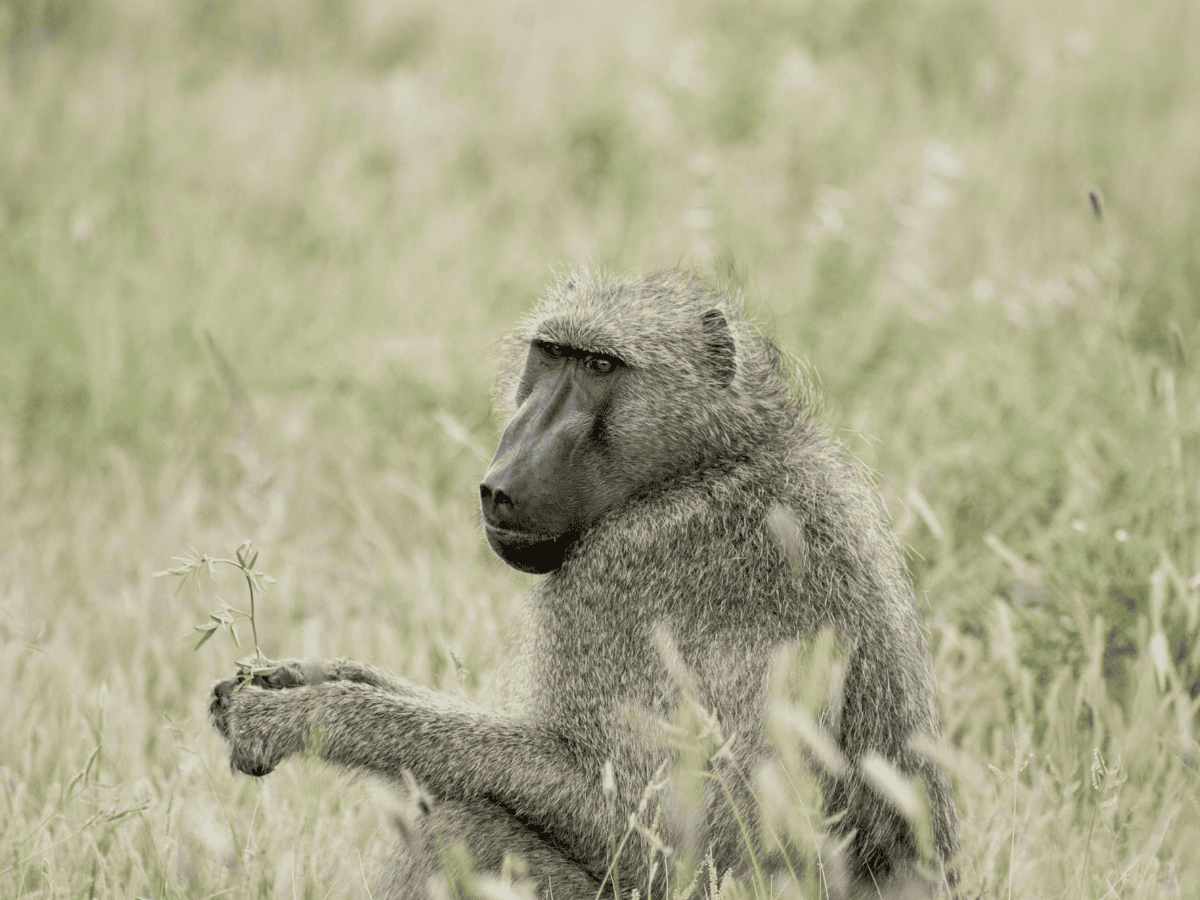
Chacma Baboons are large monkeys with long snouts and dog-like faces. Their fur is grey-brown, and males are larger with thicker manes. They move in troops. They may be confused with vervet monkeys, but baboons are larger and more robust.
Behaviour
Chacma baboons are omnivores that feed on fruits, insects, and small animals. They live in large troops with complex social structures. On safari, they are seen foraging, grooming, or interacting.
Diet
Chacma baboons are omnivores with a very varied diet that includes fruits, seeds, grasses, insects, and small animals. They feed mostly during the day, moving in groups as they search for food. They are opportunistic and will eat whatever is available. They may also raid crops or scavenge near human areas. During dry seasons, they rely more on roots and hardy food sources. Their flexible diet supports their ability to live in many different habitats.
Habitat
Chacma baboons are found in a wide range of habitats including savanna, woodland, mountains, and coastal areas. Their habitat flexibility allows them to adapt to many environments. They prefer areas with access to water and safe sleeping sites like cliffs or large trees. Terrain can vary widely. Travellers frequently see baboons in troops across many reserves, often near roads, rivers, or rocky areas where they forage and move together.
Conservation Status
Chacma baboons are listed as least concern, with stable populations. Their biggest threats include conflict with people, especially near settlements. They are highly adaptable and thrive in many environments. Strong populations exist in protected areas. Safari tourism supports these ecosystems and promotes coexistence.
Interesting Facts
Chacma baboons are highly intelligent primates with complex social structures. They live in large troops and communicate using a range of vocalisations and body language. Baboons are opportunistic feeders, eating everything from fruits to small animals. They are known for their bold behaviour and can become habituated to humans in some areas. Their social interactions and antics often provide entertaining sightings on safari.
Folklore
Chacma baboons are often associated with intelligence, social complexity, and adaptability. In some African folklore, they are portrayed as clever and sometimes mischievous, reflecting human-like behaviour. Their strong social structures reinforce themes of hierarchy and cooperation. Their presence highlights the connection between humans and wildlife.