

Gemsbok (Oryx) | A Complete Safari Guide
Understand gemsbok behaviour and where to see them in arid regionsOverview
The gemsbok, also known as oryx, is a striking desert antelope recognised by its bold black and white facial markings and long, straight horns. It is found mainly in the dry regions of southern Africa, especially in deserts and semi-arid landscapes like the Kalahari. Gemsbok are well adapted to harsh conditions and can survive with very little water. For travellers, they stand out as one of the most iconic animals of desert safaris. Their resilience and strong presence make them a memorable part of these unique environments.









Gallery
Summary
Best Places To See
Gemsbok are most reliably seen in arid, open landscapes where they are highly adapted to harsh conditions, with Kgalagadi Transfrontier National Park standing out as a flagship destination due to its strong populations and excellent visibility across dry riverbeds and dune systems. In South Africa, private reserves such as Tswalu Kalahari offer exceptional sightings supported by low tourism density and expert guiding. In Namibia, Etosha National Park provides consistent encounters, particularly around waterholes where gemsbok gather, while the surrounding desert and savanna environments ensure sightings remain frequent and easy to track.
Best Time Of Year To See
The best time to see gemsbok is during the dry season, when they concentrate around limited water and grazing areas in arid environments. Sparse vegetation improves visibility. In the wet season, they can spread out across wider areas with more available food, although sightings remain relatively consistent due to their preference for open terrain.
Identification
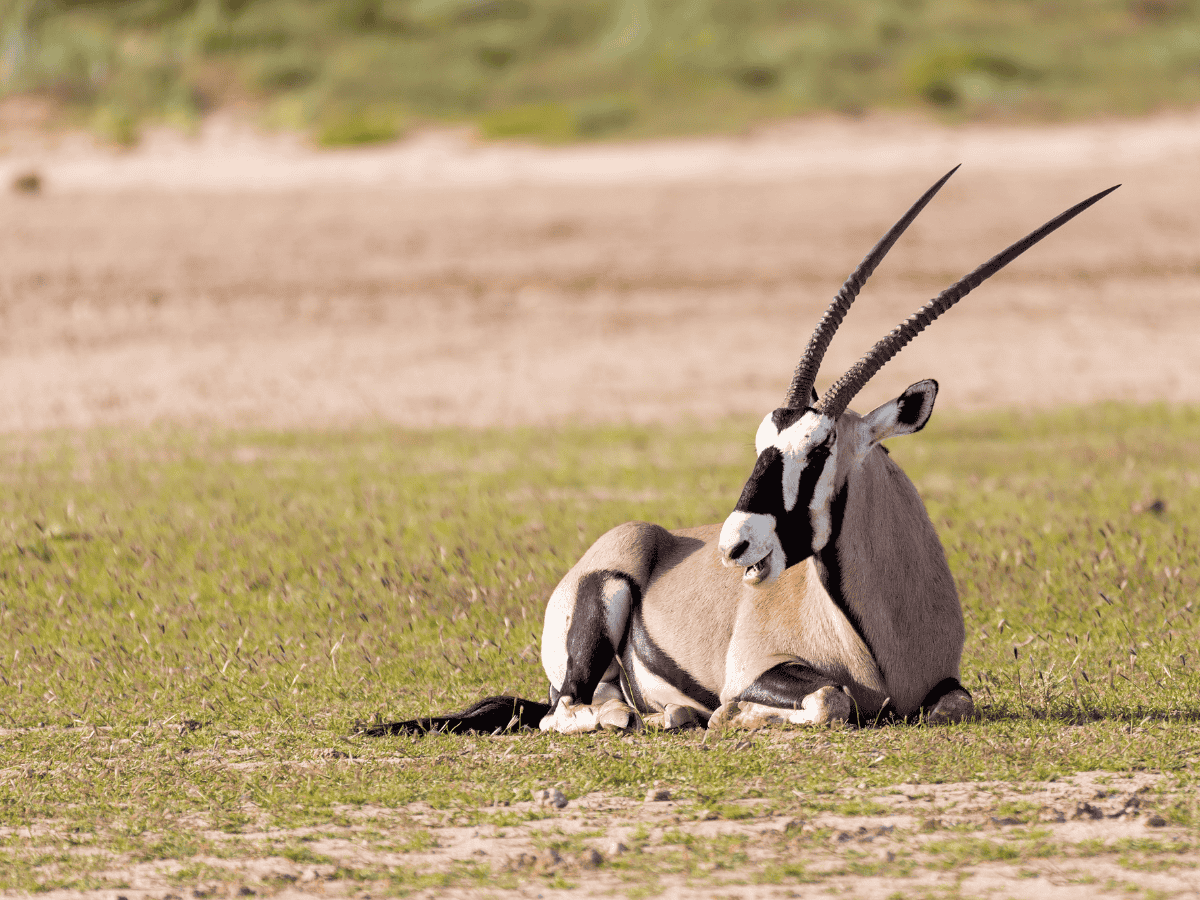
Gemsbok are large antelope with long, straight horns and striking black-and-white facial markings. Their bodies are pale grey with darker legs. Both males and females have horns. They may be confused with other antelope, but their straight horns and facial pattern are distinctive. They are well adapted to desert environments.
Behaviour
Gemsbok are adapted to arid environments and feed on grass and shrubs. They can survive with little water. They live in small groups. On safari, they are seen in dry areas, often standing still or moving slowly.
Diet
Gemsbok are hardy antelope that feed on grasses, roots, bulbs, and shrubs in dry environments. They are well adapted to desert conditions and can survive without drinking water for long periods. They dig for roots and tubers to access moisture and nutrients. Feeding usually takes place in cooler hours. During extreme heat, they reduce activity. Their diet allows them to survive in harsh environments where few other large animals can. Their feeding behaviour helps them remain independent of permanent water sources.
Habitat
Gemsbok inhabit arid and semi-arid regions such as deserts, scrublands, and dry savannas. Their habitat is defined by extreme conditions, low rainfall, and sparse vegetation. They are well adapted to heat and can survive without regular water. Terrain is usually flat or gently rolling with open visibility. Travellers are most likely to see gemsbok in desert regions where their striking appearance stands out against the landscape, often in small groups or pairs.
Conservation Status
Gemsbok are listed as least concern, with stable populations in arid regions. Their biggest threats include habitat loss and limited water availability in some areas. They are well adapted to harsh environments, which helps them survive where other species cannot. Strong populations exist in protected desert and semi-desert areas. Conservation efforts focus on maintaining these ecosystems. Safari tourism supports these regions and helps protect gemsbok populations.
Interesting Facts
Gemsbok are desert specialists, perfectly adapted to survive in harsh, arid environments. They can withstand high temperatures and obtain moisture from the plants they eat. Both males and females have long, straight horns that can be used for defence. Their striking black-and-white facial markings make them stand out against desert landscapes. Gemsbok are known for their resilience and ability to thrive where few other large mammals can.
Folklore
Gemsbok are often associated with endurance, survival, and resilience in harsh desert environments. Their ability to thrive in arid regions has made them symbols of strength and adaptability. In some traditions, they represent self-reliance and persistence. Their striking horns also contribute to their image as powerful and balanced animals.