
Martial Eagle | A Complete Birding Guide
Understand Martial Eagle identification and where sightings are most likelyOverview
The Martial Eagle is one of Africa’s largest and most powerful eagles, with a broad wingspan and strong build. It is found in open savannas and woodlands across Africa. Often seen perched high or soaring, it hunts large prey including birds and small mammals. Its size and hunting ability make it one of the most impressive raptors on safari.








Gallery
Summary
Best Places To See
Martial Eagles are most reliably found in large, open savanna and woodland where extensive territories support hunting and nesting. Kruger National Park offers some of the most consistent sightings, particularly in areas with large trees and high prey availability. Kgalagadi Transfrontier National Park provides a strong complementary option with open terrain that allows for excellent visibility of soaring birds. These locations are reliable because vast protected landscapes, low disturbance, and abundant prey allow the species to hunt widely while remaining detectable from a distance.
Best Time Of Year To See
Martial Eagles can be seen throughout the year, but sightings are often most consistent during warmer months when thermal currents support soaring behaviour and prey activity increases. During this time, birds are more frequently seen gliding at visible heights. Breeding season may also improve detection, as individuals become more territorial and active around nesting areas. In cooler months, activity may decrease slightly. Late morning to early afternoon is often the most productive period, when soaring conditions are optimal.
Identification
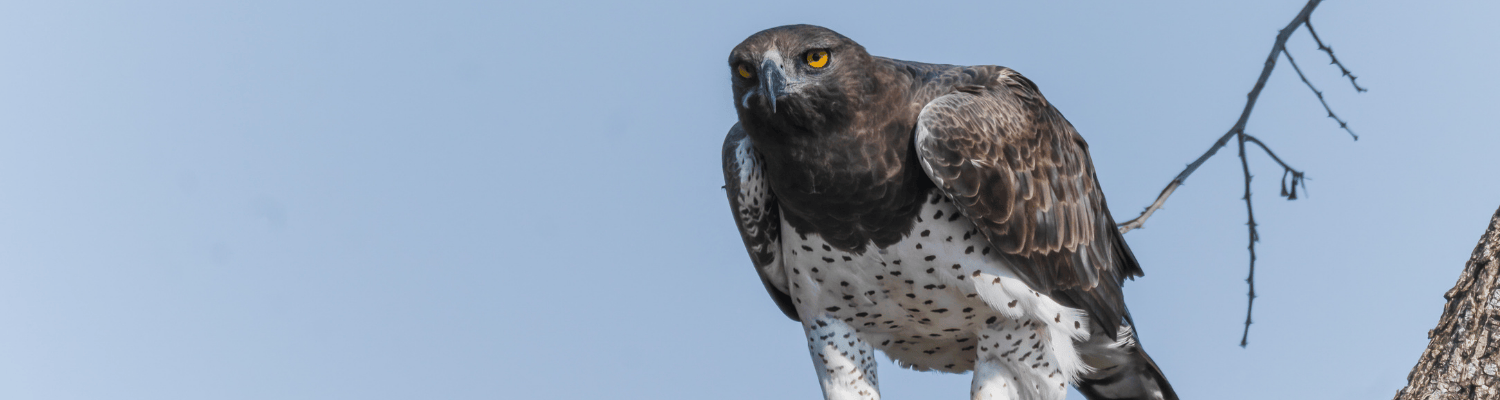
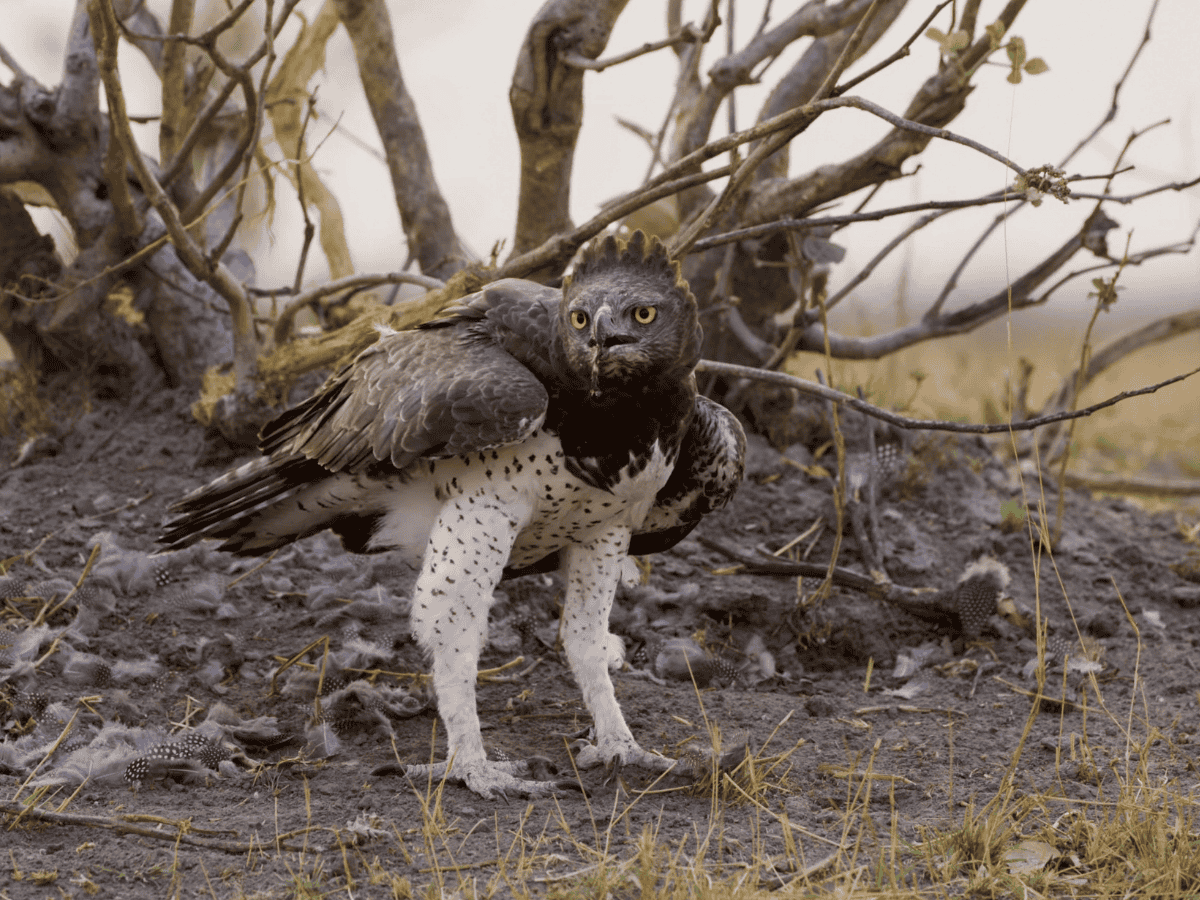
Martial Eagles are very large raptors with broad wings, a relatively short tail, and a powerful, heavy build. They have pale underparts marked with dark spots and a darker back. The head is strong with a hooked bill and sharp eyes. In flight, they appear steady and imposing. Males and females are similar, although females are significantly larger. They can be confused with other large eagles, but their size and spotted underparts help distinguish them.
Behaviour
Martial Eagles feed on a wide range of prey, including mammals, birds, and reptiles, often targeting larger animals than most other raptors. They hunt by soaring high before making fast, powerful dives to capture prey. The species is usually solitary or seen in pairs and occupies very large territories. Travellers are most likely to observe them soaring at height or perched in tall trees scanning the landscape.
Diet
Martial Eagles have a varied and powerful diet, including small antelope, monkeys, birds, and reptiles. They hunt using speed and strength, often striking prey from above with great force. Feeding activity is linked to prey availability, which is generally stable across seasons. Their diet reflects their position as apex aerial predators, capable of taking a wide range of animals within their habitat.
Habitat
Martial Eagles prefer open savanna, woodland, and semi-arid regions where large trees provide nesting sites and open ground supports hunting. They are most often seen soaring over open landscapes or perched in prominent trees. This habitat supports both their wide-ranging movement and hunting strategy. Travellers are most likely to encounter them in large reserves with minimal disturbance and good visibility.
Conservation Status
Martial Eagles are considered endangered, with populations declining due to habitat loss, persecution, and human-related pressures. Their need for large territories makes them particularly vulnerable to environmental change. Protected areas such as Kruger National Park and Kgalagadi Transfrontier National Park play a crucial role in supporting remaining populations. Conservation efforts focus on habitat protection and reducing human-wildlife conflict. Responsible tourism and awareness are essential for their long-term survival.
Interesting Facts
Martial Eagles are capable of taking prey much larger than most birds of prey, including small antelope. They can soar for long periods, covering vast distances within their territory. Their nests are large and often reused for many years. Despite their size, they can be difficult to spot due to their tendency to soar at great heights.
Folklore
Large eagles are often symbols of power and authority in African folklore. Martial Eagles, with their strength and dominance, may represent leadership and control. Their ability to hunt large prey reflects courage and capability. In some interpretations, apex predators are seen as guardians of balance, reinforcing their connection to strength and order within natural systems.