

Pel’s Fishing Owl | A Complete Birding Guide
Discover where to find Pel’s Fishing Owl and how to identify itOverview
Pel’s Fishing Owl is a large, powerful owl with rich brown plumage and large dark eyes. It is found along rivers and waterways in parts of Africa. Active at night, it hunts fish from overhanging branches. Its size, habitat, and rarity make it one of the most sought-after birds for dedicated birders.









Gallery
Summary
Best Time Of Year To See
Pel’s Fishing Owls can be seen throughout the year, but sightings are most consistent during warmer months when water levels are stable and fish activity increases. During this time, feeding becomes more frequent, improving chances of detection. Breeding season may also increase vocal activity, making birds easier to locate at night. In cooler months, activity may decrease slightly. Evening and early night provide the best opportunities, when birds leave roosts to hunt along river edges.
Identification
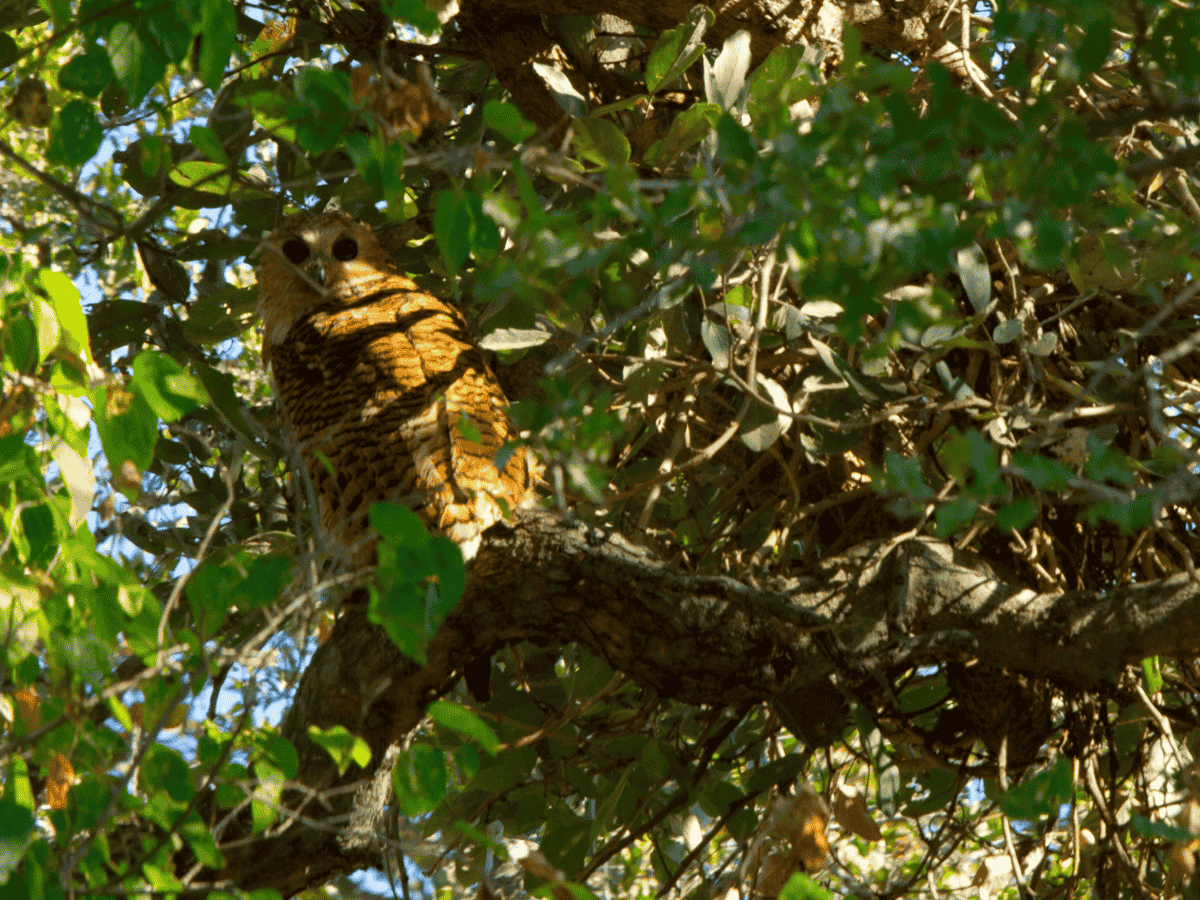
Pel’s Fishing Owls are large owls with rich rufous-brown plumage, a rounded head, and large dark eyes. They lack ear tufts and have strong, featherless legs adapted for fishing. Their size and uniform colouring make them distinctive. Males and females are similar, although females are slightly larger. They can be confused with other large owls, but their habitat and size help distinguish them clearly.
Behaviour
Pel’s Fishing Owls feed mainly on fish, which they catch by swooping down from a perch and grabbing prey from the water’s surface. They are nocturnal and spend the day resting quietly in dense trees near water. The species is usually solitary or seen in pairs and may call with deep, resonant hoots. Travellers are most likely to observe them at night along rivers or hear them calling from hidden roosts.
Diet
Pel’s Fishing Owls feed primarily on fish, but may also take frogs and other aquatic animals. They hunt by watching from a perch before gliding silently to the water to capture prey with their talons. Feeding activity is closely linked to fish availability and water conditions. Warmer months generally support higher feeding success due to increased prey movement.
Habitat
Pel’s Fishing Owls prefer slow-moving rivers, floodplains, and wetlands with large trees along the banks. They are most often found in dense riverine woodland where suitable roosting and nesting sites are available. This habitat supports both feeding and shelter. Travellers are most likely to encounter them along quiet waterways with mature vegetation and minimal disturbance.
Conservation Status
Pel’s Fishing Owls are considered near threatened, with populations affected by habitat loss, disturbance, and changes to river systems. Their dependence on specific riverine environments makes them sensitive to environmental change. Protected areas such as Kruger National Park and Mana Pools National Park play a key role in supporting populations. Conservation of river systems and surrounding vegetation is essential for their survival.
Interesting Facts
Pel’s Fishing Owls are among the largest owls in Africa and are highly specialised for catching fish. They have strong, unfeathered legs that help them grip slippery prey. Their silent flight allows them to approach water without disturbance. They are rarely seen during the day, making sightings particularly special.
Folklore
Owls are often associated with mystery and night in African folklore. Pel’s Fishing Owls, with their nocturnal habits and deep calls, may symbolise hidden knowledge and quiet awareness. Their connection to water reflects depth and reflection. In some interpretations, owls represent insight and perception beyond the visible world, reinforcing their link to understanding within natural systems.
Best Places To See
Pel’s Fishing Owls are most reliably found along slow-moving rivers with large, mature trees that provide roosting and nesting sites. Kruger National Park offers some of the most consistent sightings, particularly along well-wooded river systems where suitable habitat remains intact. Mana Pools National Park provides a strong complementary option with extensive riverine forest and stable water conditions. These locations are reliable because calm waterways, abundant fish populations, and large trees create ideal conditions for both feeding and daytime roosting.