

Southern Banded Snake Eagle | A Complete Birding Guide
Learn where to spot Southern Banded Snake Eagle and identify itOverview
The Southern Banded Snake Eagle is a medium-sized raptor with grey and white plumage and a strong, hooked bill. It is found in coastal forests and woodlands in parts of East and Southern Africa. Often perched quietly, it hunts reptiles. Its specialised diet and limited range make it a rewarding sighting.








Gallery
Summary
Best Places To See
The Southern Banded Snake Eagle is most reliably found in coastal forest and adjacent woodland where dense vegetation supports reptile populations. iSimangaliso Wetland Park offers some of the most consistent sightings, particularly in areas where forest meets open clearings and provides suitable hunting perches. Hluhluwe-iMfolozi Game Reserve provides a strong complementary option with mixed woodland and good visibility. These locations are reliable because a combination of dense habitat, open hunting areas, and stable prey availability allows the species to perch visibly while scanning for food.
Best Time Of Year To See
The Southern Banded Snake Eagle can be seen throughout the year, but sightings are most consistent during warmer months when reptiles are more active and easier to locate. During this time, increased prey movement supports more frequent hunting behaviour, improving visibility. Breeding season may also increase calling and territorial activity. In cooler months, reptile activity decreases, making sightings less predictable. Late morning and early afternoon are often productive, when rising temperatures encourage reptile movement and hunting opportunities.
Identification
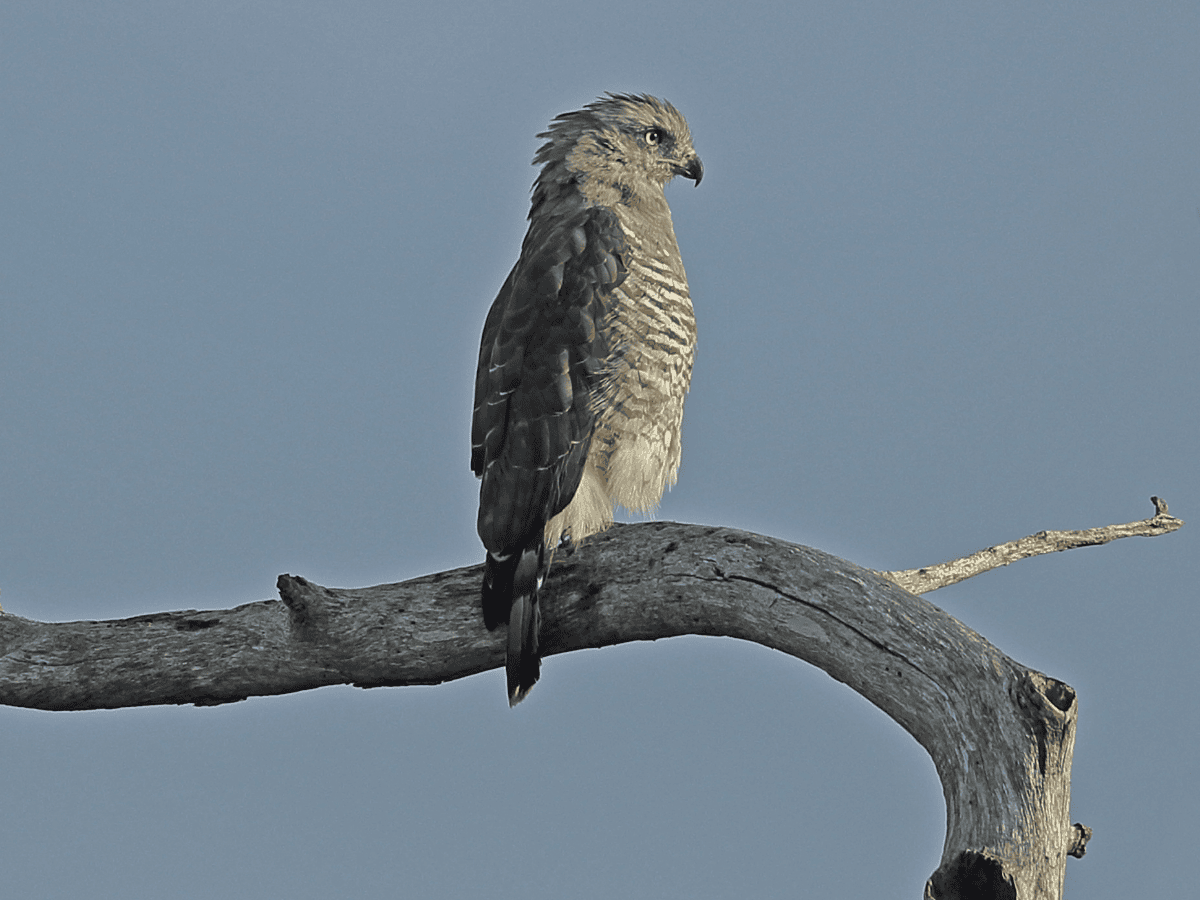
The Southern Banded Snake Eagle is a medium-sized raptor with grey-brown plumage, a relatively large head, and bright yellow eyes. It has broad wings and a short tail, giving it a compact appearance in flight. Its underparts may show faint banding, though this can be subtle. Males and females are similar in appearance. It can be confused with other snake eagles, but its softer colouring, forest-edge habitat, and eye colour help distinguish it.
Behaviour
The Southern Banded Snake Eagle feeds mainly on snakes and other small reptiles, hunting from a perch where it watches for movement below. It often remains still for extended periods before making a quick, controlled strike. The species is usually solitary and highly territorial. It may call occasionally, especially during breeding season. Travellers are most likely to observe it perched quietly in trees, scanning the ground or making short hunting flights.
Diet
The Southern Banded Snake Eagle feeds primarily on snakes, as well as lizards and other small reptiles. It hunts by watching from a perch and then descending to capture prey with precision. Feeding activity is closely linked to reptile behaviour, which increases during warmer conditions. Its specialised diet reflects its role as a predator of reptiles within woodland and forest-edge ecosystems.
Habitat
The Southern Banded Snake Eagle prefers coastal forest, dense woodland, and well-vegetated savanna where reptile populations are supported. It is most often found perched in trees overlooking open ground or clearings. This habitat provides both cover and hunting opportunities. Travellers are most likely to encounter it in areas where forest transitions into more open landscapes.
Conservation Status
The Southern Banded Snake Eagle is considered near threatened, with populations affected by habitat loss and degradation, particularly in coastal regions. Its reliance on specific habitat types makes it sensitive to environmental change. Protected areas such as iSimangaliso Wetland Park and Hluhluwe-iMfolozi Game Reserve play an important role in maintaining suitable conditions. Conservation of forest and woodland ecosystems is essential for supporting this species.
Interesting Facts
The Southern Banded Snake Eagle is highly specialised for hunting reptiles and can remain motionless for long periods while scanning for prey. Its bright yellow eyes are one of its most striking features. It is often overlooked due to its quiet behaviour and preference for dense habitat. Its presence is closely linked to healthy reptile populations and intact woodland environments.
Folklore
Raptors are often associated with vision and awareness in African folklore. The Southern Banded Snake Eagle’s focused hunting style may symbolise patience and precision. Its connection to snakes can reflect themes of control and balance within nature. In some interpretations, birds that hunt quietly from above represent careful observation and understanding, reinforcing this species’ link to awareness and subtle strength within natural systems.