
Southern Ground Hornbill | A Complete Birding Guide
Learn to identify Southern Ground Hornbill and where to find itOverview
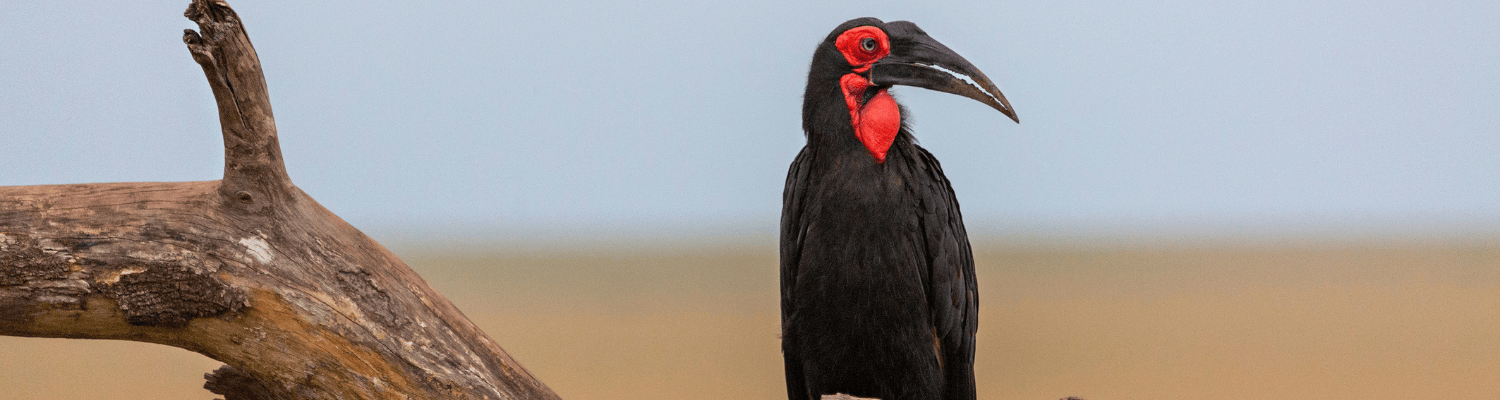
The Southern Ground Hornbill is a large, black bird with a red face and a deep, booming call. It is found in savannas and open woodlands across Southern Africa. Usually seen walking on the ground in small groups, it hunts insects and small animals. Its size, social behaviour, and call make it one of the most memorable birds on safari.









Gallery
Summary
Best Places To See
Southern Ground Hornbills are most reliably found in open savanna and woodland where large territories support group movement and feeding behaviour. Kruger National Park offers some of the most consistent sightings, particularly in areas with a mix of open ground and scattered trees where birds forage on foot. Hluhluwe-iMfolozi Game Reserve provides a strong complementary option with similar habitat and stable populations. These locations are reliable because protected landscapes, low disturbance, and suitable nesting sites allow family groups to move predictably and remain visible across large areas.
Best Time Of Year To See
Southern Ground Hornbills can be seen throughout the year, but sightings are most consistent during warmer months when feeding activity increases and groups move more actively across the landscape. During this time, breeding season may also bring increased vocalisation, making them easier to locate. In cooler months, activity may decrease slightly, although the species remains present. Early mornings are particularly productive, when birds are actively foraging and calling, often moving across open areas in search of food.
Identification
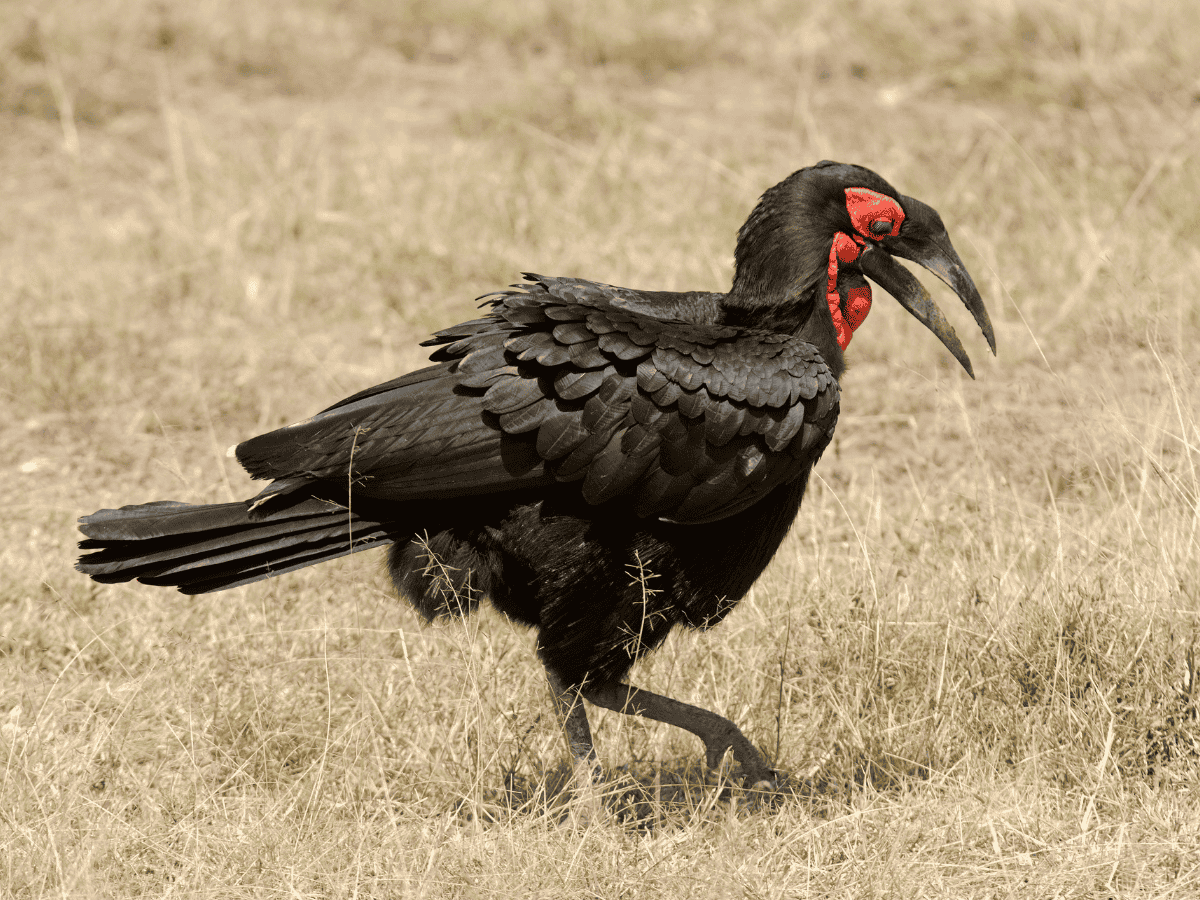
Southern Ground Hornbills are very large birds with glossy black plumage, bright red facial skin, and long legs. They have a large, heavy bill and a distinctive casque on top of the bill. The red facial skin is more pronounced in males, while females may show patches of blue on the throat. Their size and upright posture make them unmistakable. They are unlikely to be confused with other species due to their ground-dwelling behaviour and bold features.
Behaviour
Southern Ground Hornbills feed mainly on insects, reptiles, and small animals, which they hunt by walking steadily through the landscape. They use their strong bills to capture and handle prey. The species lives in cooperative family groups, often seen moving together and communicating through deep calls. Travellers are most likely to observe them walking through open areas or interacting within their group.
Diet
Southern Ground Hornbills have a varied diet that includes insects, snakes, lizards, small mammals, and occasionally birds. They forage by walking and probing the ground, using their bill to uncover prey. Feeding activity increases during warmer months when prey is more abundant. Their diet reflects their role as ground-based predators within savanna ecosystems.
Habitat
Southern Ground Hornbills prefer open savanna, grassland, and lightly wooded areas where they can move freely on the ground. They require large territories with access to both feeding areas and suitable nesting sites, such as large trees. This habitat supports their social structure and movement patterns. Travellers are most likely to encounter them in open landscapes with scattered trees and good visibility.
Conservation Status
Southern Ground Hornbills are considered vulnerable, with populations declining due to habitat loss, poisoning, and low reproductive rates. Their reliance on large territories and slow breeding makes recovery challenging. Protected areas such as Kruger National Park and Hluhluwe-iMfolozi Game Reserve play an important role in supporting populations. Conservation efforts focus on habitat protection and community awareness. Responsible tourism and conservation programmes are essential for their long-term survival.
Interesting Facts
Southern Ground Hornbills live in cooperative groups where only one breeding pair reproduces, while others help raise the young. Their deep, booming calls can be heard over several kilometres. They spend most of their time on the ground rather than flying. Their lifespan can exceed several decades, making them one of the longer-living bird species in the region.
Folklore
Southern Ground Hornbills hold strong cultural significance in many African traditions, often associated with protection and warning. Their deep calls are sometimes believed to signal change or important events. In some communities, they are seen as guardians or symbols of power. Their presence reflects awareness and connection to the land, reinforcing their role as both ecological and cultural icons within natural systems.